I have developed a few simulations that I've found useful for the classes I've taught. They are sorted below by general category.
Disclaimer: These simulations were coded in large part by Claude. I believe there are ways to be selective and critical about AI usage that, at least, reduce some of its many harms. I urge AI users to spend time developing AI literacy and considering their usage carefully. A starting point from a creator I enjoy can be found on YouTube here.
Electricity and Magnetism
 Integral Form of Ampere's Law (planned)
This simulation shows how path integrals over vector fields work and uses the specific context of Ampere's Law and magnetic fields to demonstrate this.
Optics
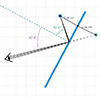 Image Formation with Flat Mirrors (in progress)
This simulation shows how images form with flat mirrors. You can observe the law of reflection in action and learn about the nature of virtual images. Working, but additional features planned!
Image Formation via Refraction (Observe the Paraxial Approximation) (planned)
See how images form when objects and observers are in different media. This sim doubles as a tool to visualize the importance of the paraxial approximation in optics.
Image Formation with Lenses (planned)
Form images with systems of lenses and observe the light rays converge and diverge. You can use converging or diverging lenses and insert up to four lenses and see how the resulting image forms.
Quantum Mechanics
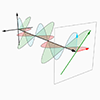 Polarization (in progress)
Visualize different polarization states across multiple representations, including visualizing the waves, seeing the polarization ellipse and the Poincare sphere, and decomposing into different bases. Play around with measuring polarized photons and manipulating polarization states with birefringent materials (coming soon).
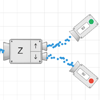 Stern-Gerlach Experiments
Set up chains of Stern-Gerlach apparatuses and collect particle count data to investigate spin-1//2 particle behavior.
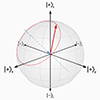 Time Evolution on the Bloch Sphere
Visualize the evolution of a spin-1/2 particle's spin state in a magnetic field on the Bloch sphere. Collect measurement data or simply observe the time evolution; view in the lab frame or a rotating frame.
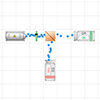 Quantum Optics Lab
Build a quantum optics experiment and collect data on single-photon counters. Explore polarization properties and interference experiments like the Mach-Zehnder interferometer.
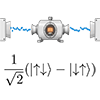 Entanglement and Bell's Inequalities
Make entangled spin particle pairs, take count and coincidence data in fixed-basis and basis-averaged experiments, and test different hidden variable models and Bell's inequalities.